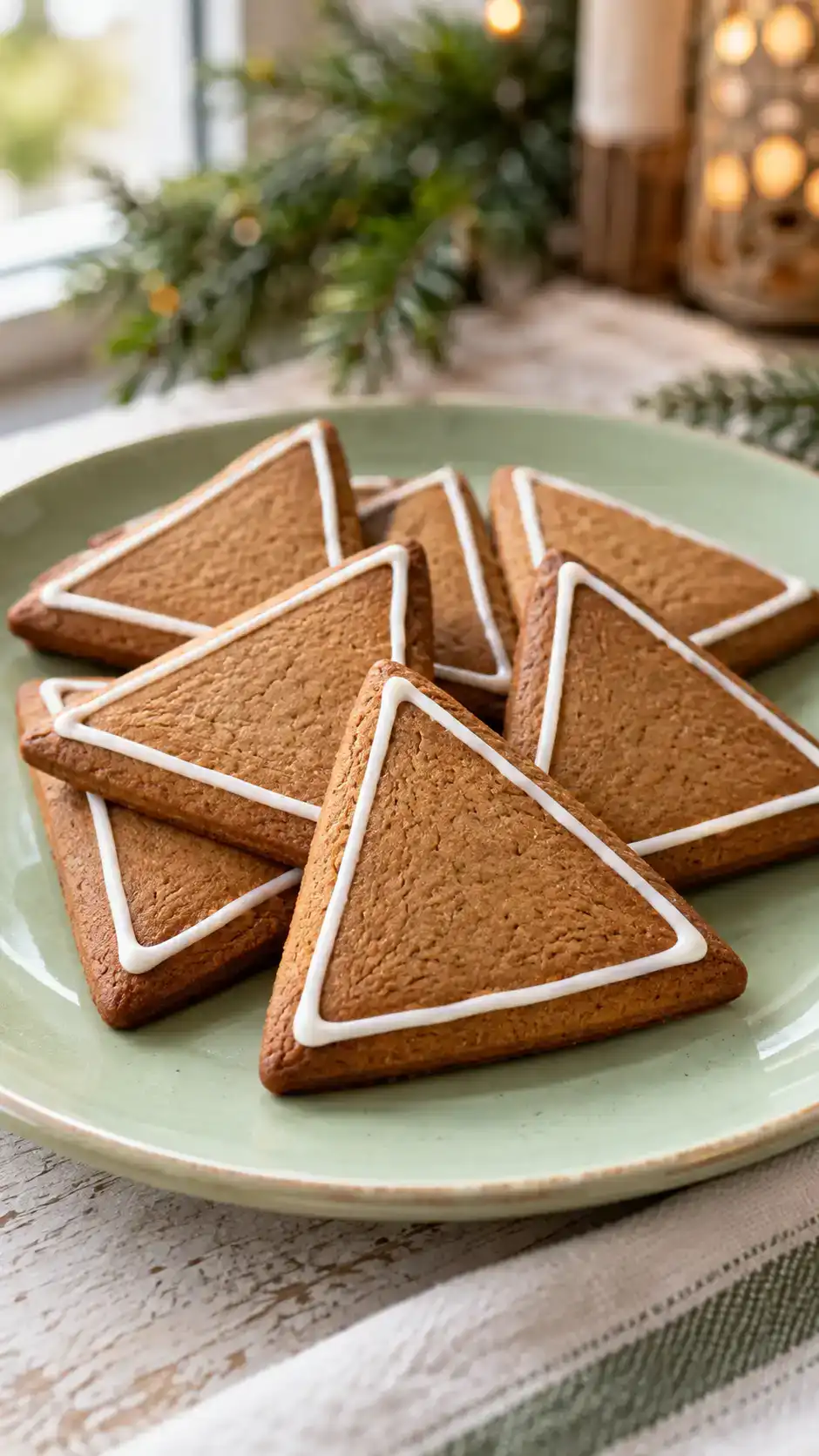
Gingerbread triangles made without baking soda or baking powder, with a dense shape-stable decorating dough.
It is part of this dough structure, not a replacement leavener.
This dough contains neither baking soda nor baking powder. Eggs and a butter-rich dough give structure without chemical leavening; the result is dense and shape-stable rather than a puffy drop cookie. Keep the measured cornstarch. Optional white outlines add decorating and drying time.
Gingerbread Cookies Without Baking Soda
Per tray: 10–14 minutes · About 3 trays of 12 shapes
Allow 96 minutes: 40 hands-on, 0 chilling, 36 for all baking trays, 20 cooling. Cooling includes the pan rest. Optional decoration, ingredient warm-up and extra trays add time.
Kitchen tools you’ll need
- Digital kitchen scale and US measures
- Electric mixer, bowl and spatula
- Rolling pin with 3/8-inch guides
- 3-inch triangle cutter or knife and ruler
- Two 13 × 18-inch baking sheets, parchment and cooling rack
Gingerbread triangles made without baking soda or baking powder, with a dense shape-stable decorating dough.
Ingredients
Scale ingredients and US equivalents, including eggs. Keep cookie size, thickness, oven temperature and baking time per tray unchanged. More trays add time; weigh beaten egg for fractional batches.
Cookie dough
Spice blend
Instructions
A · Mix
- Combine without aeratingHeat oven to 375°F (190°C) conventional, or 350°F (175°C) fan. Line pans. Beat cool butter and brown sugar until smooth, not very fluffy. Mix in molasses, then eggs one at a time. Add cornstarch, spices and salt.
- Add flour graduallyMix in flour on low until the dough gathers and releases the bowl. If sticky rather than cohesive, add flour 1 tablespoon at a time, only as needed, up to 1 extra cup (120 g). Extra flour is not included in nutrition.
B · Shape
- Roll and cutHeat to 375°F (190°C) conventional or 350°F (175°C) fan. Roll the cool dough 3/8 inch thick between parchment. Cut triangles about 3 inches tall with broad bases and place 1 inch apart on lined pans. No scheduled chill is required when dough remains cool.
C · Bake
- Set the edgesBake one tray for 10–14 minutes; check at 10, especially with fan. Edges should be firm and centers slightly softer. Let baking sheets cool before refilling.
D · Cool
- Move gentlyRest on the pan 5 minutes, then transfer to a rack for about 15 minutes. Optional prepared icing belongs on fully cooled cookies.
Chef’s Science & Pro Tips
Keep the cornstarch
It is part of this dough structure, not a replacement leavener.
Roll evenly
Dense unleavened shapes need consistent thickness to bake through evenly.
Expect less puff
Judge by set edges and a dry surface rather than waiting for a large rise.
Storage & Make-Ahead
| Method | How long | What to do |
|---|---|---|
| Room temperature | Up to 5 days | Cool completely and seal airtight in a cool, dry place. Keep soft cookies separate from crisp cookies. Let any icing dry before layering. |
| Refrigeration | Raw dough: up to 48 hours | Wrap tightly. Let dough soften just enough to roll. Plain baked cookies do not need refrigeration; follow storage instructions for any added icing. |
| Freeze raw dough | Up to 2 months at 0°F (−18°C) | Freeze wrapped flat dough discs airtight. Thaw overnight in the refrigerator, then follow the shaping and baking instructions. |
| Freeze baked cookies | Up to 2 months at 0°F (−18°C) | Freeze fully cooled, preferably undecorated cookies in an airtight container, separating layers with parchment. Thaw covered at room temperature. |
| Refresh | Just before serving | For a softer bite, microwave one plain cookie for 5 seconds and check; serve promptly. Do not heat decorated cookies. This will not reverse severe drying or overbaking. |
Notes
- This dough contains neither baking soda nor baking powder. Eggs and a butter-rich dough give structure without chemical leavening; the result is dense and shape-stable rather than a puffy drop cookie. Keep the measured cornstarch. Optional white outlines add decorating and drying time.
Nutrition
Approximate per-serving values calculated from generic ingredient weights and stated yield, including listed fillings, glaze and coating. Excludes optional decoration and bench flour. Brands, unused coating, decoration amounts and actual yield change these estimates.
 RECIPE REVIEWEDGINGERBREADGINGERBREAD COOKIES
Frequently Asked Questions
A few helpful answers before you bake.
Is baking powder used instead?
No. This formula has no chemical leavener, rather than a spoon-for-spoon replacement.
Will they be fluffy?
No. They are dense decorating cookies with limited puff.
Can I simply omit soda from any recipe?
Different doughs rely on different leavening balances. Use the whole formula here rather than removing soda from another recipe.
 Follow The Cookie Index on Pinterest
Share a little gingerbread joy
Send this recipe to someone who loves to bake.